
Rebuilding Hotels.com Loyalty
Leading end-to-end experience design for "Stay 10 nights, get £100” in the UK and "Stay 10 nights, get 10%” back across 42 global markets
Opportunity
When Hotels.com transitioned to One Key's flat earn model, members lost the simple “stay 10 nights, get 1 free” promise they loved. Between 2019 and 2024, this change triggered severe business decline: customer numbers dropped 36%, room nights fell 35%, and Gold member booking intent plummeted from 56% to 30%, with nearly a third of churned users specifically citing One Key. The challenge was to rebuild an intuitive, high-perceived-value rewards experience without re-architecting the underlying platform from scratch. We addressed this by designing two parallel propositions: 10:100 (“Stay 10 nights, get £100”) to stop customer churn in the UK, and 10:1 (“Stay 10 nights, get 10% back in Hotels.comCash”) to modernise loyalty across international markets.
Approach
As design lead for the end-to-end membership experience, I ran a team of 6 product designers, 2 content designers, and 1 researcher across multidisciplinary distributed pods to design and ship journeys across Onboarding, Search, Property Pages, Checkout, Trips, and the Rewards Hub. I established the core visual language around a punch-card progress tracker and restructured the information architecture so users saw the headline promise first rather than fine print. Because platform data and timing were tight, I worked closely with product, engineering, legal, analytics, and customer support to make pragmatic calls on what shipped on Day 1 versus Day 2. Reusing our international 10:1 design system as the baseline allowed us to adapt the pattern quickly and launch 10:100 in the UK within an intensive eight-week window.
Outcomes (Launch Snapshot)
Both programs launched on schedule and delivered immediate commercial impact. In the UK, 10:100 rolled out to 9.5 million members and drove an instant turnaround, lifting join rates between 10.7% and 16.4% year-over-year against an $85 million incremental NBV target. Internationally, the 10:1 pilot migrated 2.97 million members in Italy and Taiwan. In Taiwan, daily average NBV rose 30.3% overall and 23.5% among Gold members, while Italy's performance stayed within target ranges. These results validated the model and formed the blueprint for rollout across 42 additional markets, representing an estimated $40 million incremental NBV opportunity for 2026.
Post-Launch Performance
Subsequent data reads added important operational reality. In the UK, 10:100 drove strong gains in the Blue tier and generated $4 million in incremental NBV through targeted winback campaigns, but overall incremental NBV tracked roughly 40% below target because higher-spending Gold members found the fixed £100 reward diluted. This insight quickly triggered fast-follow optimisations, including stacked-value messaging and improved checkout earn modules. At the same time, the 10:1 system scaled rapidly, completing all three rollout waves
Let’s noodle on the details
Overview
Rebuilding Hotels.com loyalty by leading the design of 10:100 in the UK and 10:1 across international markets
Hotels.com used to have a very clear loyalty promise: stay 10 nights and get roughly 1 free. When that shifted into One Key’s flatter cross-brand earn model, the proposition became harder to understand and felt less valuable to many Hotels.com travellers.
That loss of clarity was tied to a broader brand problem. Between 2019 and 2024, Hotels.com lost 36% of customers, 35% of room nights, and 25% of revenue despite travel demand growing by roughly 25%. Gold member intent to book all stays with Hotels.com fell from 56% to 30%, and around 30% of churned UK and US customers explicitly cited One Key as a reason for leaving.
The challenge was to restore a simple, compelling Hotels.com loyalty story without rebuilding the underlying platform from scratch. I led the design of two connected programmes: 10:100 in the UK, “stay 10 nights, get £100”, and 10:1 for rest-of-world markets, “stay 10 nights, get 10% back in Hotels.comCash”. Together, they were designed to bring back a clearer value proposition while creating a reusable pattern that could scale across many markets.
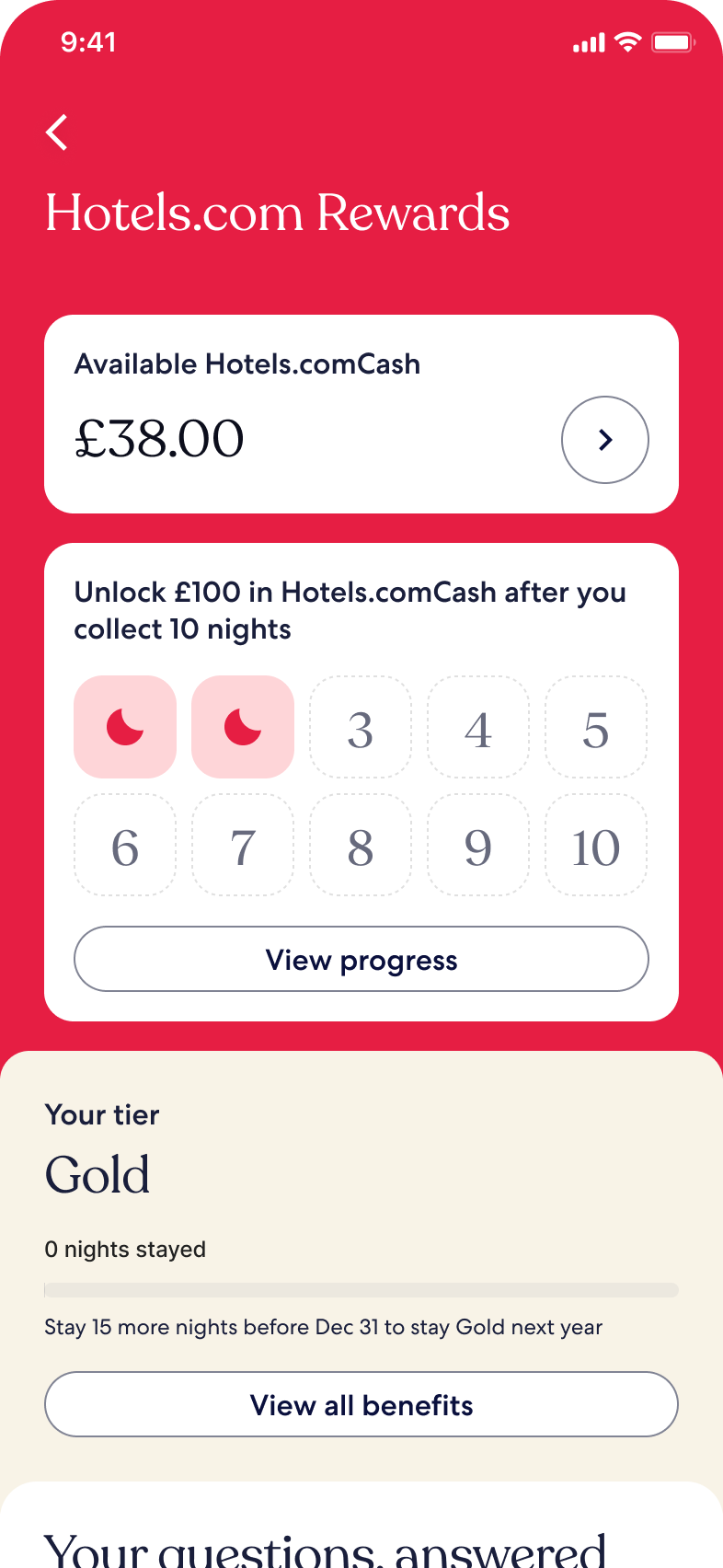
10 for 1 (UK)
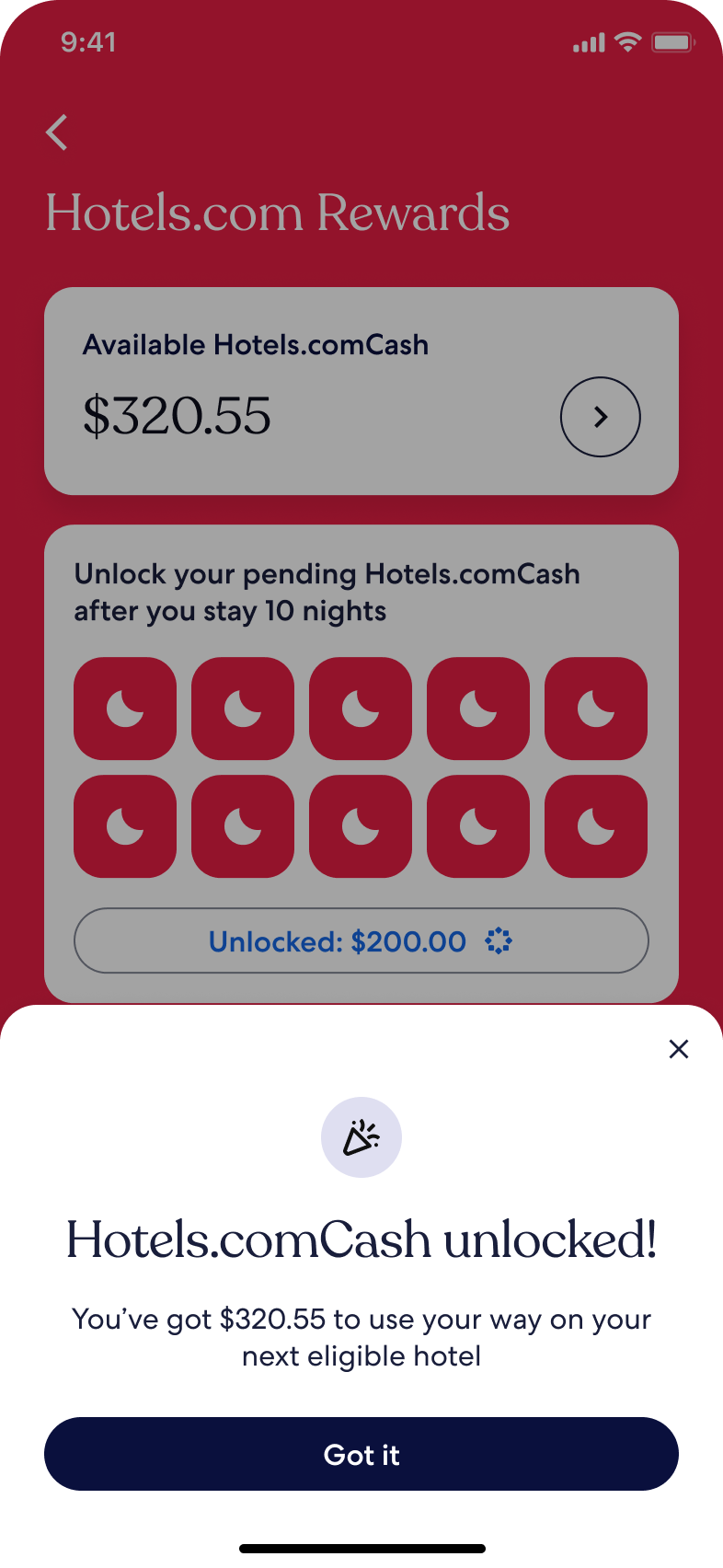
10 for 1 (International Markets)
My Role
I was the design lead for the Hotels.com membership experience across both programmes. I set the design direction for how the new loyalty proposition should come to life across Onboarding, Home, Search, Property Pages, Checkout, Trips, and Rewards Hub, and defined the shared patterns for how rewards should be explained, visualised, and carried consistently across 10:1 and 10:100.
Team Structure
I led a multidisciplinary team of 6 product designers, 2 content designers, and 1 researcher across overlapping workstreams, each supporting dedicated development pods and product managers. Some parts of the experience sat squarely within loyalty, while others relied on placements in spaces owned by adjacent teams, which meant the role required constant alignment and design leadership. Once the direction was aligned with senior leadership and the programme moved into delivery, my focus shifted to helping the team scale the work quickly and consistently across journeys, use cases, and surfaces in time for coordinated marketing communications and launch.
What I owned directly
I was accountable for the end-to-end membership experience across Home, Search Results, Property pages, Checkout, Trips, the Rewards Hub, Onboarding, and the Pillar page, while also defining the shared visual and interaction language for punch cards, nights progress, Hotels.comCash, and other loyalty touchpoints across the journey. The work also involved shaping the design response to platform constraints, including clear decisions about what shipped on Day 1 versus what moved into a deliberate Day 2 roadmap, alongside creating a shared analytics specification for the key comprehension and progression moments across both programmes.
Team focus and delivery pace
I set the operating rhythm that helped the work move at speed. Through planning, scope definition, critiques, intake, prioritisation, and day-to-day decision-making, I aligned designers, researchers, and content partners around a clear quality bar and delivery plan. That helped the team stay focused on the highest-impact work, make pragmatic trade-offs across platform constraints and dependencies, and deliver against aggressive timelines across overlapping programmes. Adapting the 10:1 baseline made an approximately eight-week 10:100 delivery window achievable.
Organisational alignment
I acted as the integration point across product, TEaL, content design, legal, servicing, analytics, and engineering. I helped turn cross-functional trade-offs into clear design decisions, built confidence across teams with different goals and constraints, and was a named decision-maker in judging whether the IT/TW baseline was ready to scale across ROW.
Traveller Problem and Opportunities
The international markets were still on a similar rewards program, hadn’t been migrated to ‘One Key ’, and only required a shift to the updated visual identity experience and new brand currency (Hotels.comCash). However, frequent UK travellers who loved the old “stay 10 nights, get 1 free” Rewards program found the new setup (‘One Key’ and ‘OneKeyCash’) less rewarding and harder to understand and were unsure whether it was worth sticking with Hotels.com.
10:1 modernised the old Hotels.com promise into a reusable, scalable system.
In Italy and Taiwan, 10:1 was the proving ground: stay 10 nights, get 10% back in Hotels.comCash. It preserved the emotional logic of classic Hotels.com rewards while moving onto Northstar and the pooled currency model. That choice mattered strategically: in markets that had not yet been migrated to One Key, the aim was to modernise the legacy Hotels.com programme without losing the clearer, more motivating Hotels.com value story. The pilot is now fully live, roughly 2.97 million members have been migrated, and the design system has become the baseline for the next phase of ROW rollout.
10:100 translated the same system into a simpler, more market-specific value story for the UK.
For the UK, the proposition became stay 10 nights, get £100. That sounds like a copy change, but it was much more than that. The programme needed to address damaged perceptions of loyalty in a major market, work through a large member migration, and still sit on the same underlying infrastructure. It is now live on Hotels.com UK, with ongoing enhancements focused on post-launch quality, celebration moments, and the richer edges of the experience.
Restore the perceived value of rewards
Frequent UK travellers who loved the old “stay 10 nights, get 1 free” program feel they’re getting less in return and can’t easily see what they're earning today. 10:100 is a chance to clearly show “stay 10 nights, get £100 back” and make Hotels.com feel rewarding again.
Rebuild clarity and trust
A simple, transparent punch card experience can reset expectations and show that we heard travelers’ feedback and this change is to benefit them.
Deepen engagement
10:100 lets us surface eligibility, progress and benefits at every step of the journey, turning each search, PDP view, checkout and Rewards Hub visit into a moment that nudges them towards their next £100.
Blueprint for the US and other markets
In the case of 10:100, the UK launch becomes the blueprint for what Hotels.com Rewards should look like in the US and other markets, de-risking a larger global rollout.
Before 10:1
Comparison between OneKey and 10:100 in the UK
Approach
This work had to move quickly and hold together across a wide group of stakeholders. The timelines were aggressive, the programmes overlapped, and decisions in one area often had knock-on effects across product, legal, servicing, content, analytics, and engineering. My approach was to create enough alignment and reuse that the team could move fast without creating new confusion for travellers.
Reuse the pattern, not the confusion
I structured the work around two principles: pattern reuse and do-no-harm. I led 10:1 IT/TW as the reference implementation, then adapted those patterns into 10:100 rather than designing a second loyalty system from scratch. That created a reusable foundation for wider rollout and made a compressed UK implementation window feasible.
Lead with the promise
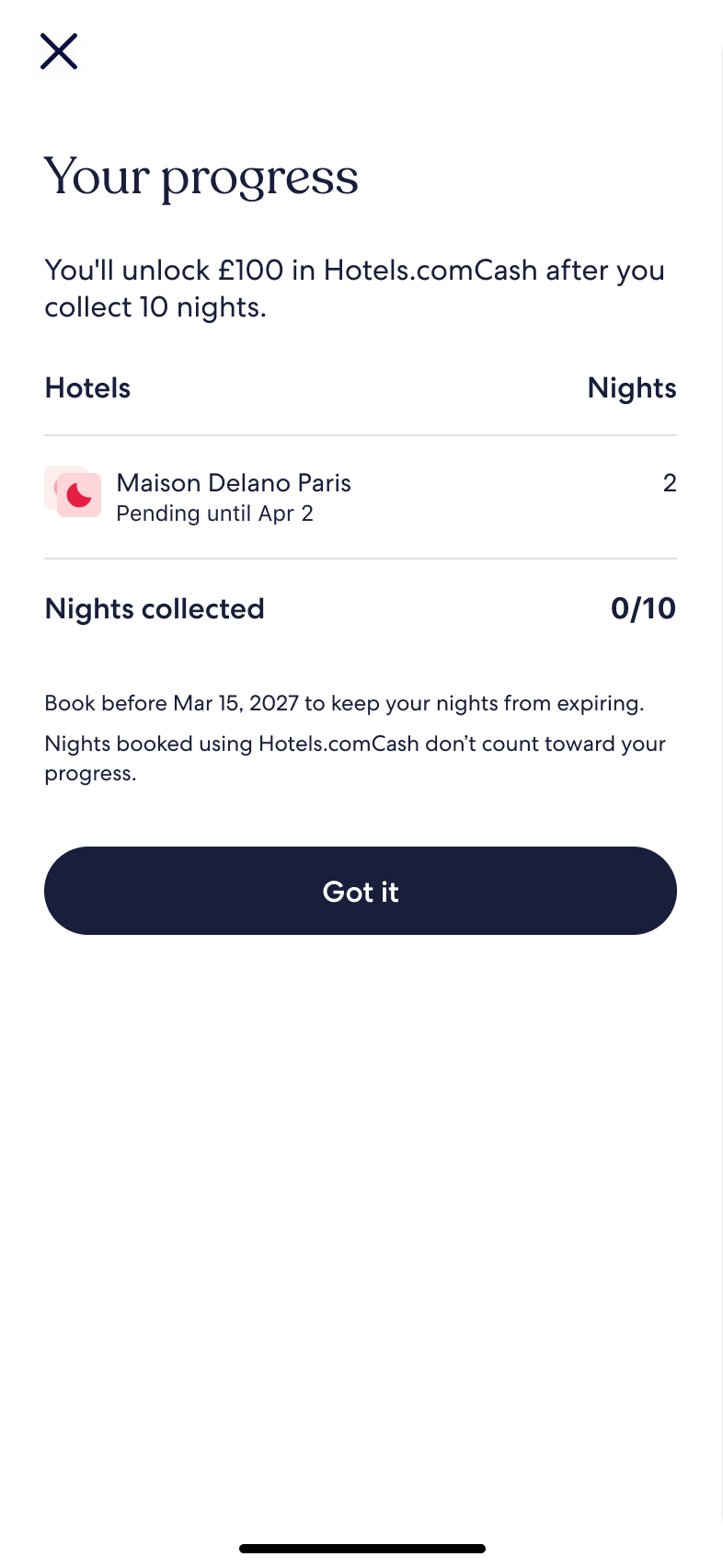
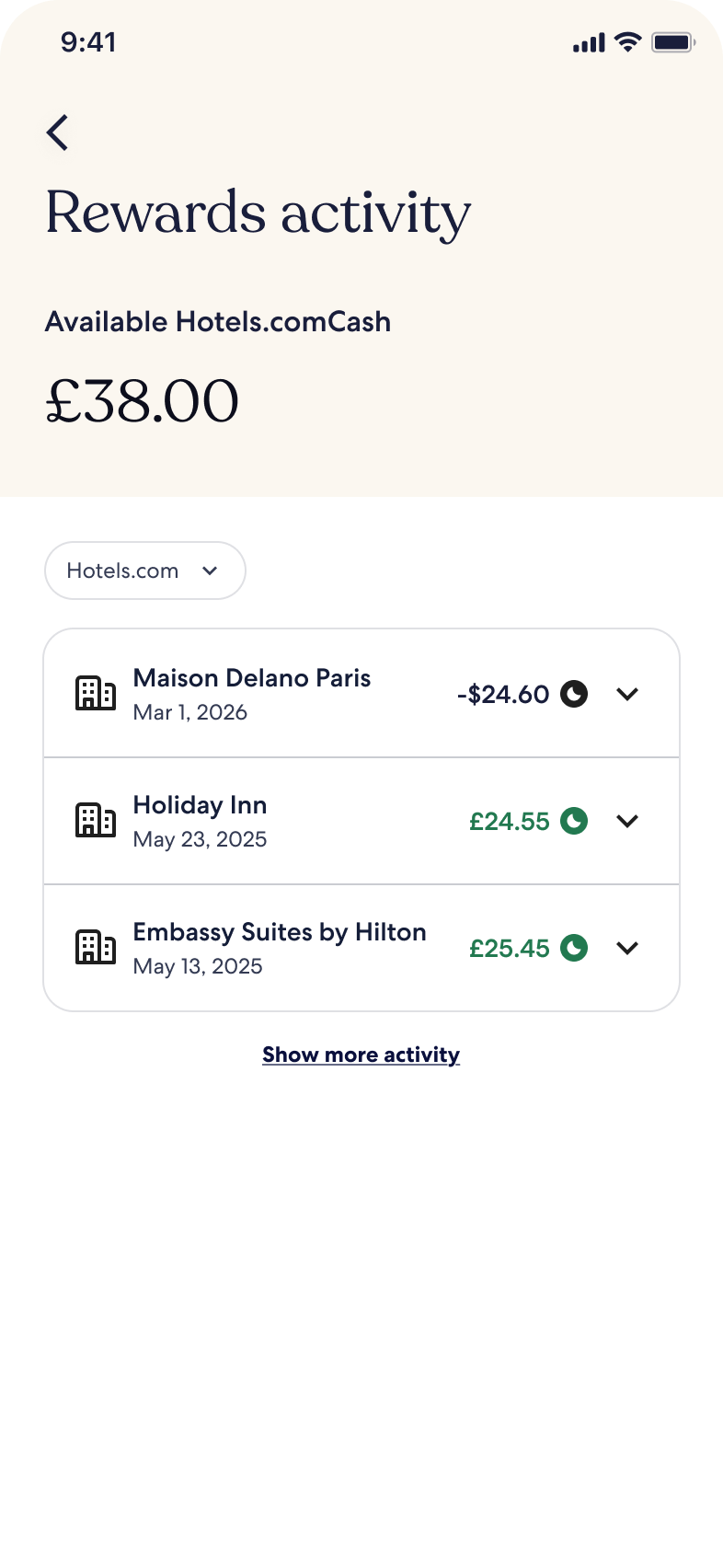
The biggest design move was to simplify the story travellers encountered across the journey: lead with the promise, make progress visible, clarify pending versus available rewards, and avoid overpromising where the platform could not support the ideal experience. In practice, doing things in the right order meant making the headline value proposition clear first, then using the next layer of the experience to explain how Hotels.comCash worked, what counted towards progress, what was still pending, and when value could actually be used. Research showed that once travellers saw the value proposition presented in the right order, they could explain it accurately and clearly recognise its value.
Design for scale, not just launch
I was not just designing a UK experience or two test markets. 10:1 expansion had to work across all markets with different payment products, currencies, local regulations, support realities, and launch requirements. In practice, that meant designing a system that could remain consistent at its core while accommodating meaningful differences, such as local payment methods, multi-currency behaviour, tax treatment, gift card rules, and market-specific eligibility edge cases. The all-markets business case made clear that scale depended on absorbing these local differences without breaking the overall value proposition, weakening comprehension, or creating long-tail operational overhead for teams supporting the experience after launch.
Design challenges across the user journey
-
Lead with the promise, not the rules
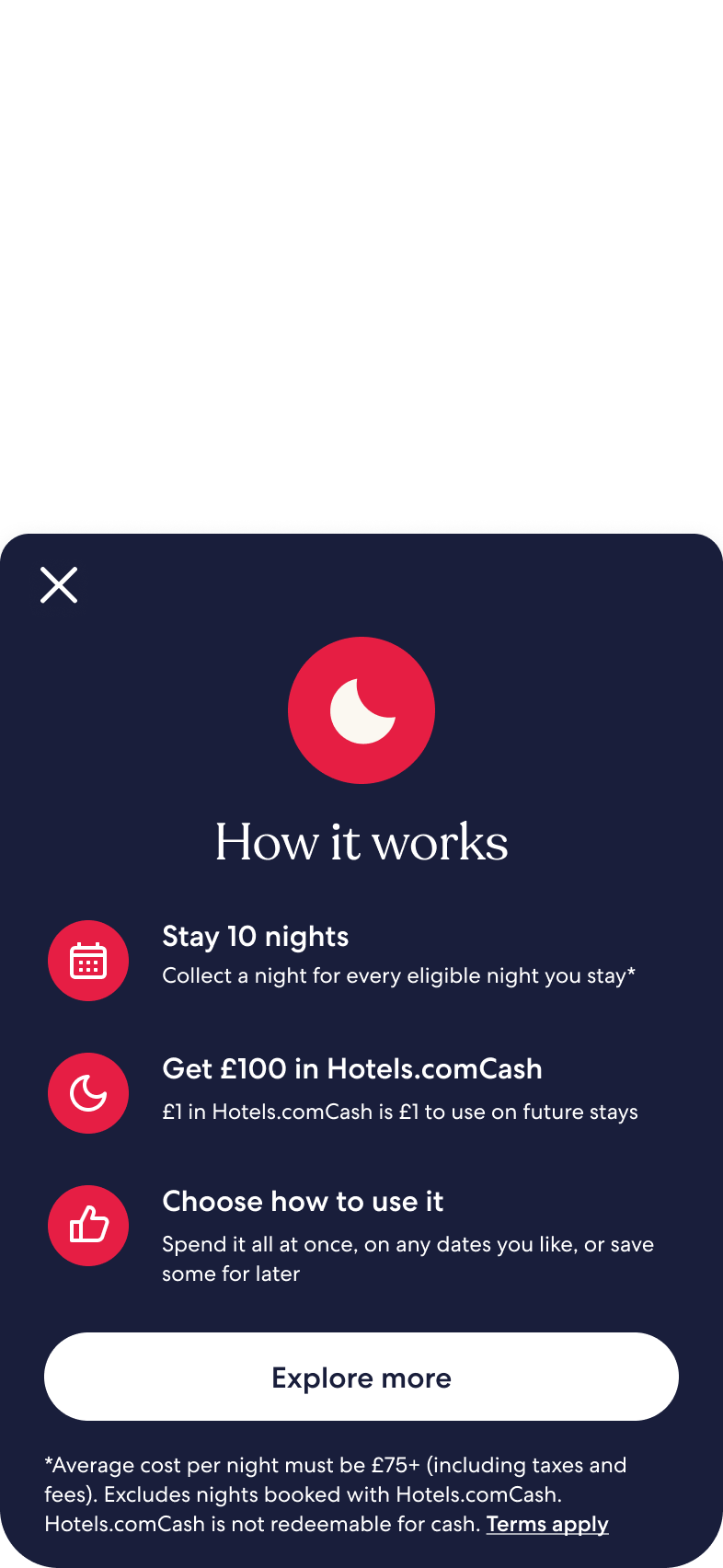
Early research showed users were seeing detailed eligibility information before they had formed the basic mental model of the programme. I drove a hierarchy pivot so the headline value proposition landed first, with rules moved into a secondary layer. That reframed comprehension as an information architecture problem, not just a messaging problem.
Early 10:100 UX sessions showed travellers hitting detailed eligibility content before the core promise. One participant misread “£1 in Hotels.comCash = £1 to use” as £1 earned per £1 spent. I responded by shifting the hierarchy so “stay 10 nights, get £100” consistently led, with explanatory detail accessible as a secondary layer. Post-iteration research showed travellers could explain the programme more accurately once the order was corrected.
-
Manage change at scale without over-promising
For 10:100, Home and pre-notification surfaces had to introduce a new programme to millions of existing members inside strict legal and brand windows. I coordinated design direction, content consistency, visual continuity, and sign-off across teams so the change felt intentional rather than abrupt.
The UK launch required notifying roughly 9.5 million existing loyalty members within strict legal windows, while also avoiding overpromising capabilities the new construct did not support. I helped shape Home and pre-notification experiences that worked for different member cohorts, removed outdated One Key framing from Hotels.com surfaces, and maintained continuity between comms and the in-product experience.
-
Protect trust when the ideal state is not feasible
Checkout had an attractive unlock-preview concept, but the platform could not reliably calculate it in time for launch. I reframed the moment around accurate eligibility messaging instead of speculative reward projection, and preserved the richer state as an explicit Day-2 enhancement rather than an abandoned idea.
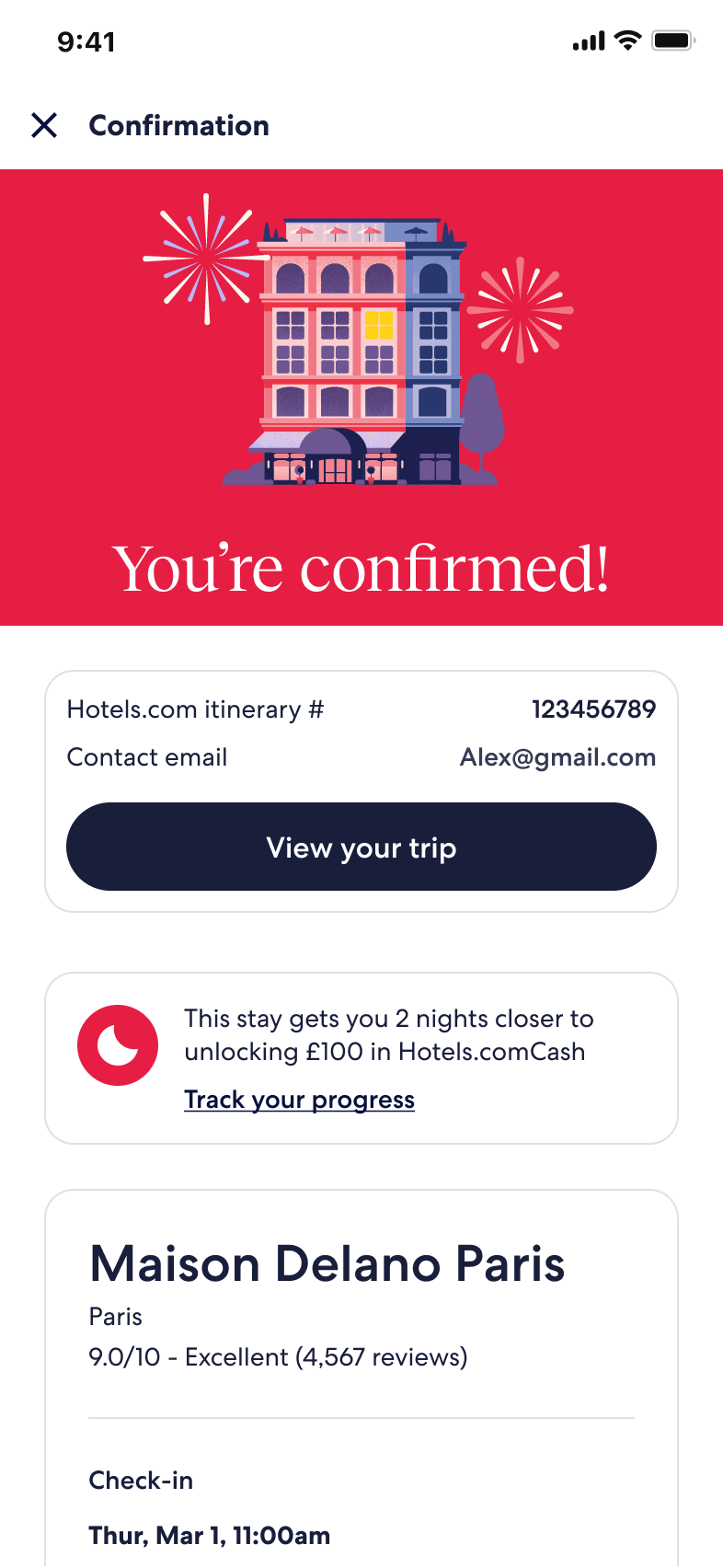
At checkout, the ideal design included a reward-unlock preview showing what a booking would contribute towards the next reward. Platform limitations meant that the data was not reliable enough to ship that experience at launch. Rather than push an exciting but fragile design, I reframed the moment around accurate eligibility messaging so travellers could clearly understand whether a booking counted and why.
-
At launch, UK travellers could still have older One Key bookings sitting alongside new 10:100 bookings. Rebranding everything at once created too much risk close to launch, so I aligned a phased solution: preserve legacy wording where needed for day one, while applying the new pattern only where the data and experience were reliable. Framing that as a deliberate phased decision rather than a compromise helped protect the launch without sacrificing long-term design intent.
-
Make progress feel motivating and measurable
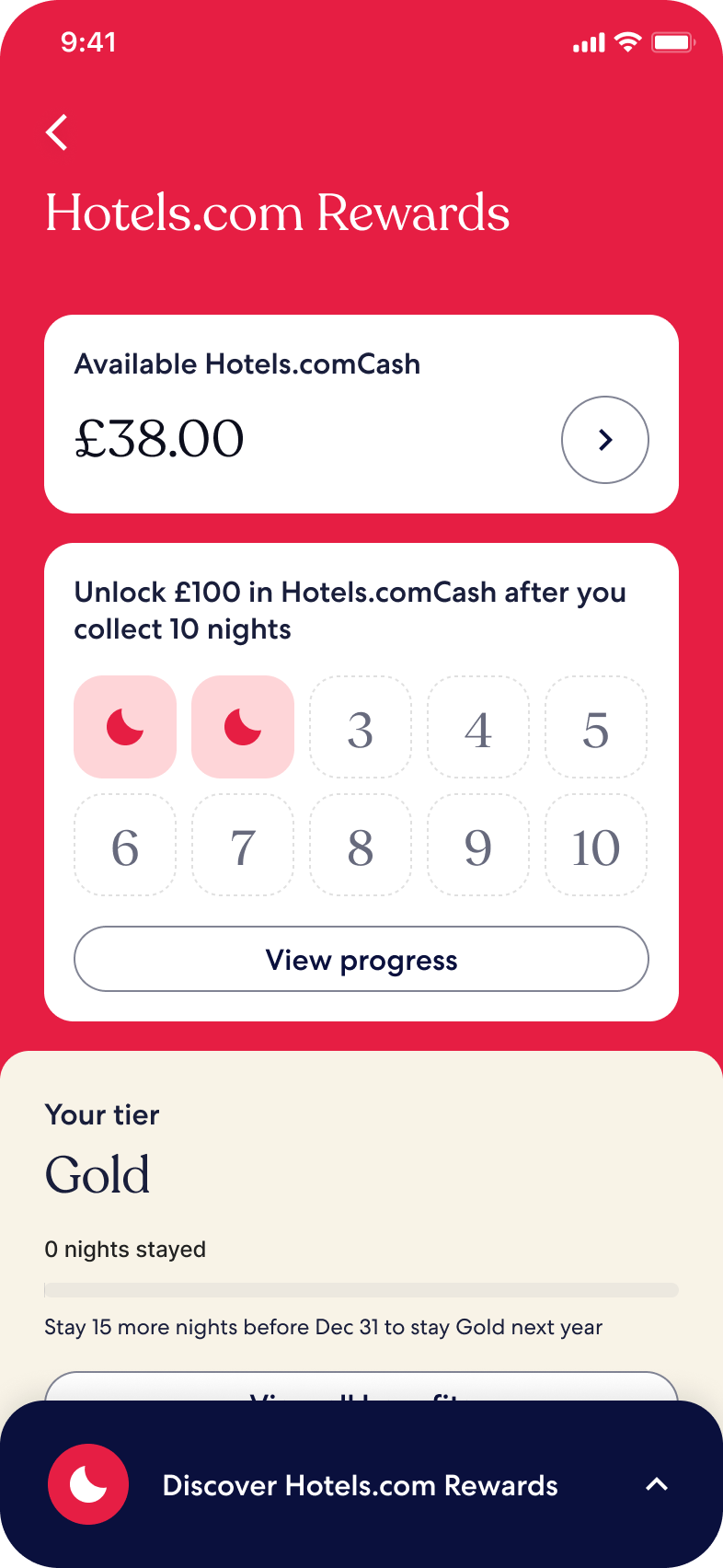
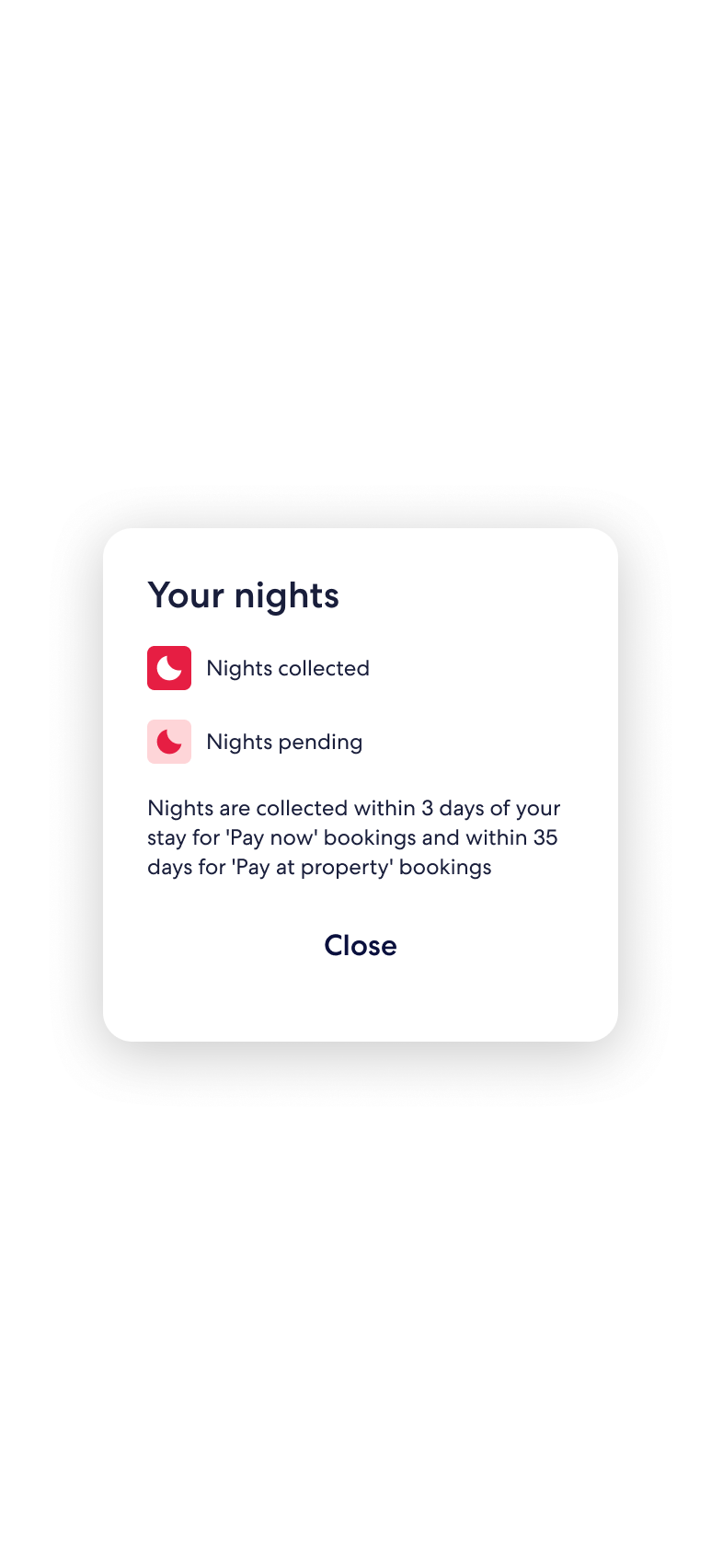
The punch-card mechanic created excitement, but users did not always understand the difference between pending and confirmed nights. I worked with the team to sharpen that distinction visually, create stronger calls to inspect progress, and instrument the entire interaction model so the effect could be measured rather than guessed.
Research showed that travellers often understood they were collecting nights, but not that some of those nights were still pending. The punch-card pattern was motivating, but it could imply completion more strongly than it explained status. I pushed the experience towards a clearer distinction between pending and confirmed progress, stronger activity cues, and more transparent supporting guidance so Rewards Hub stayed motivating without becoming misleading.
Stay 10 nights, get £100 (UK)
-
![]()
1
-
![]()
2
-
![]()
3
-
![]()
4
-
![]()
5
-
![]()
6
-
![]()
7
-
![]()
8
-
![]()
9
-
![]()
10
-
![]()
11
-
![]()
12
-
![]()
13
-
![]()
14
-
![]()
15
-
![]()
16
-
![]()
17
-
![]()
18
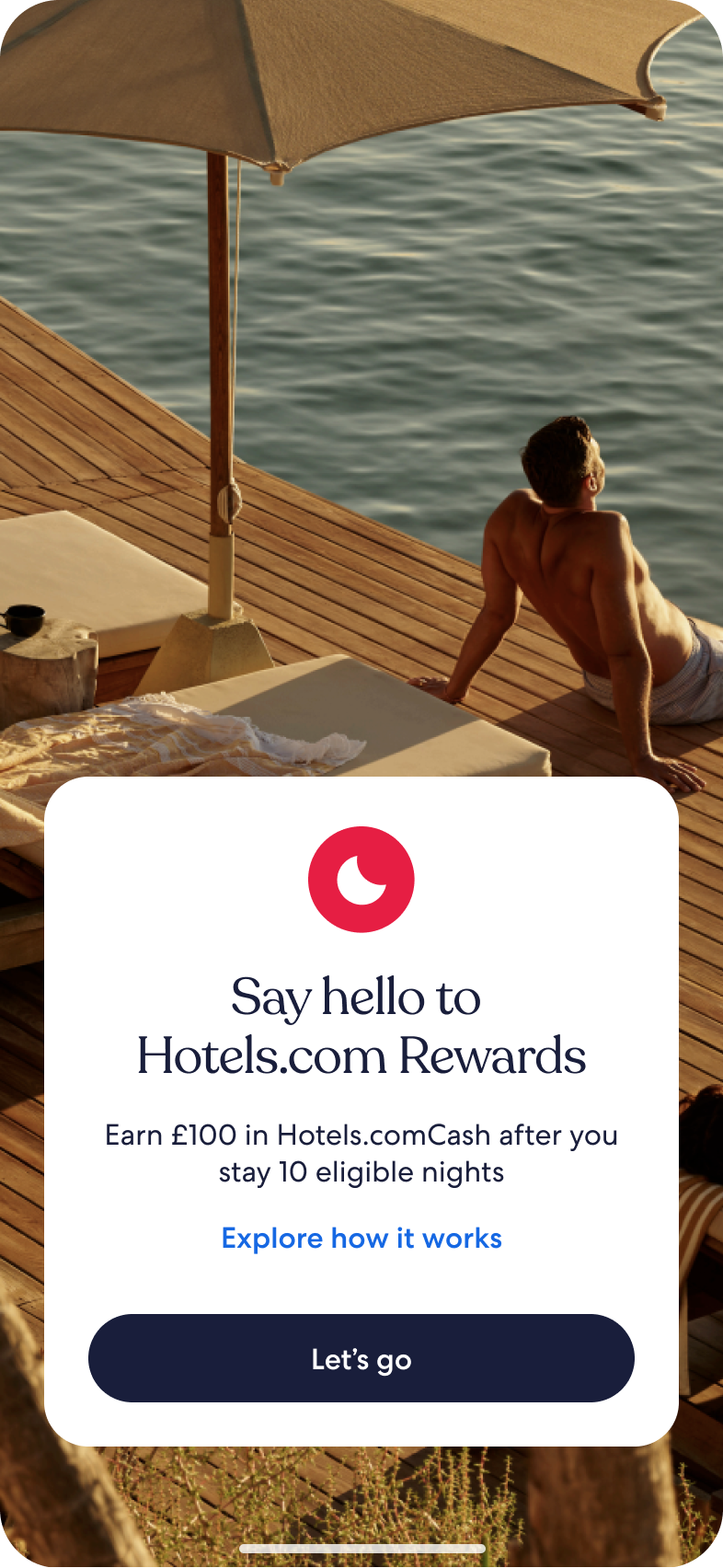
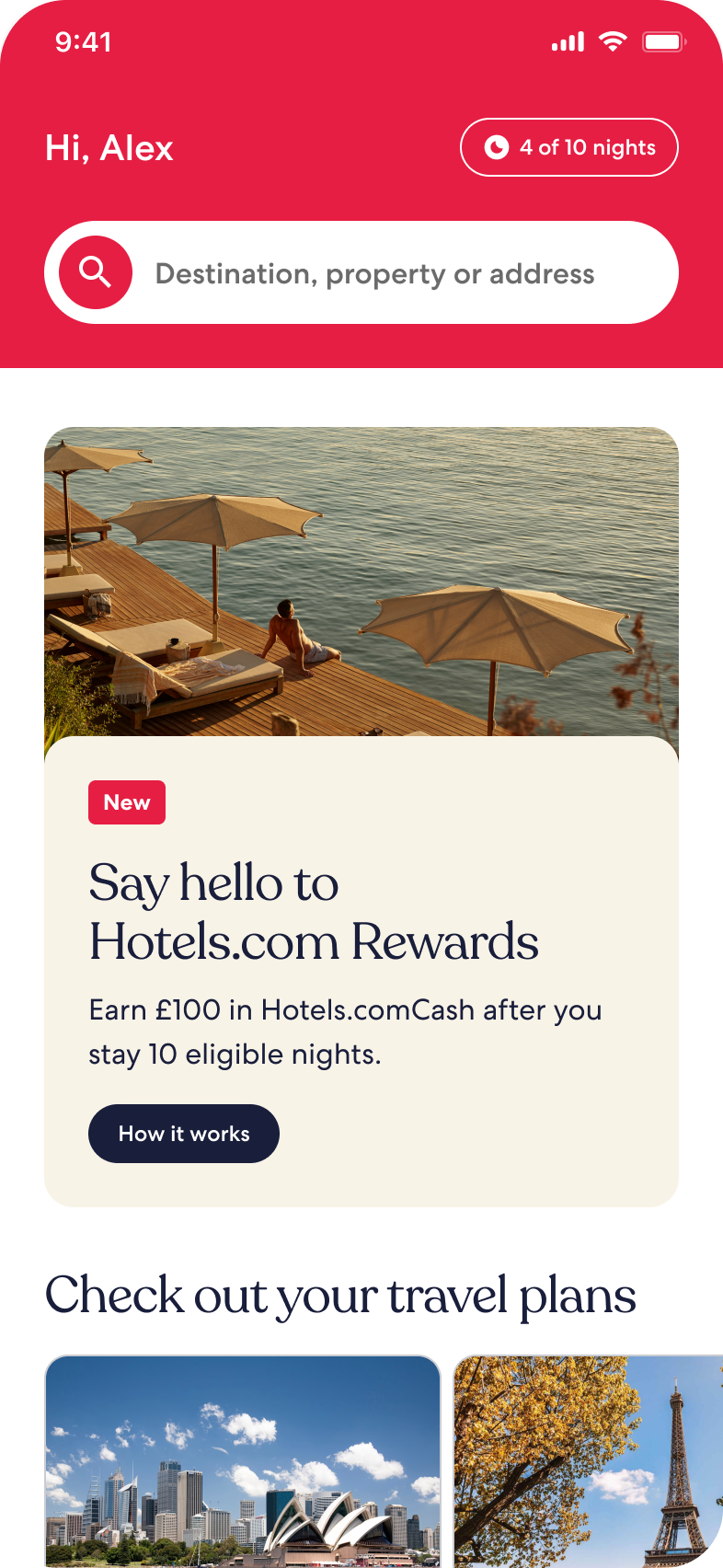
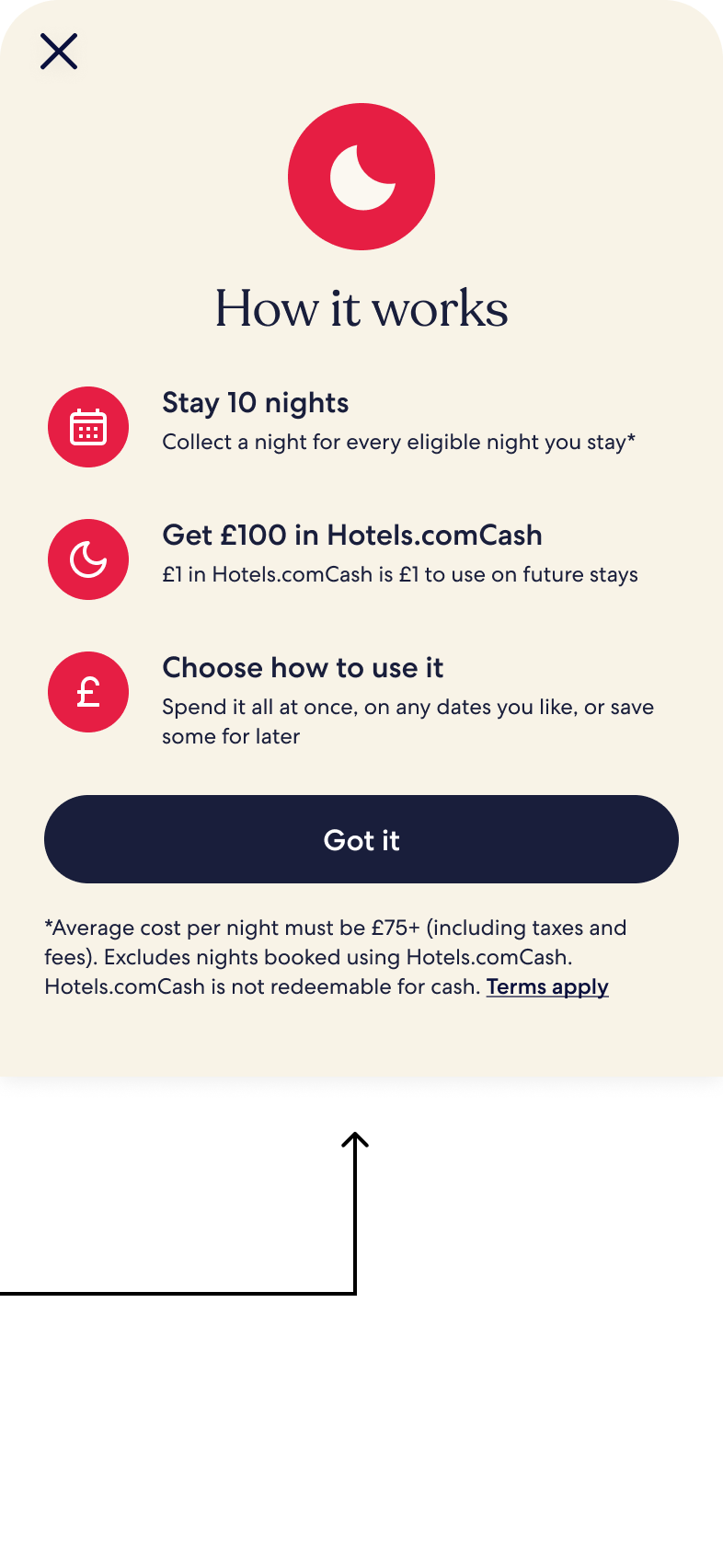
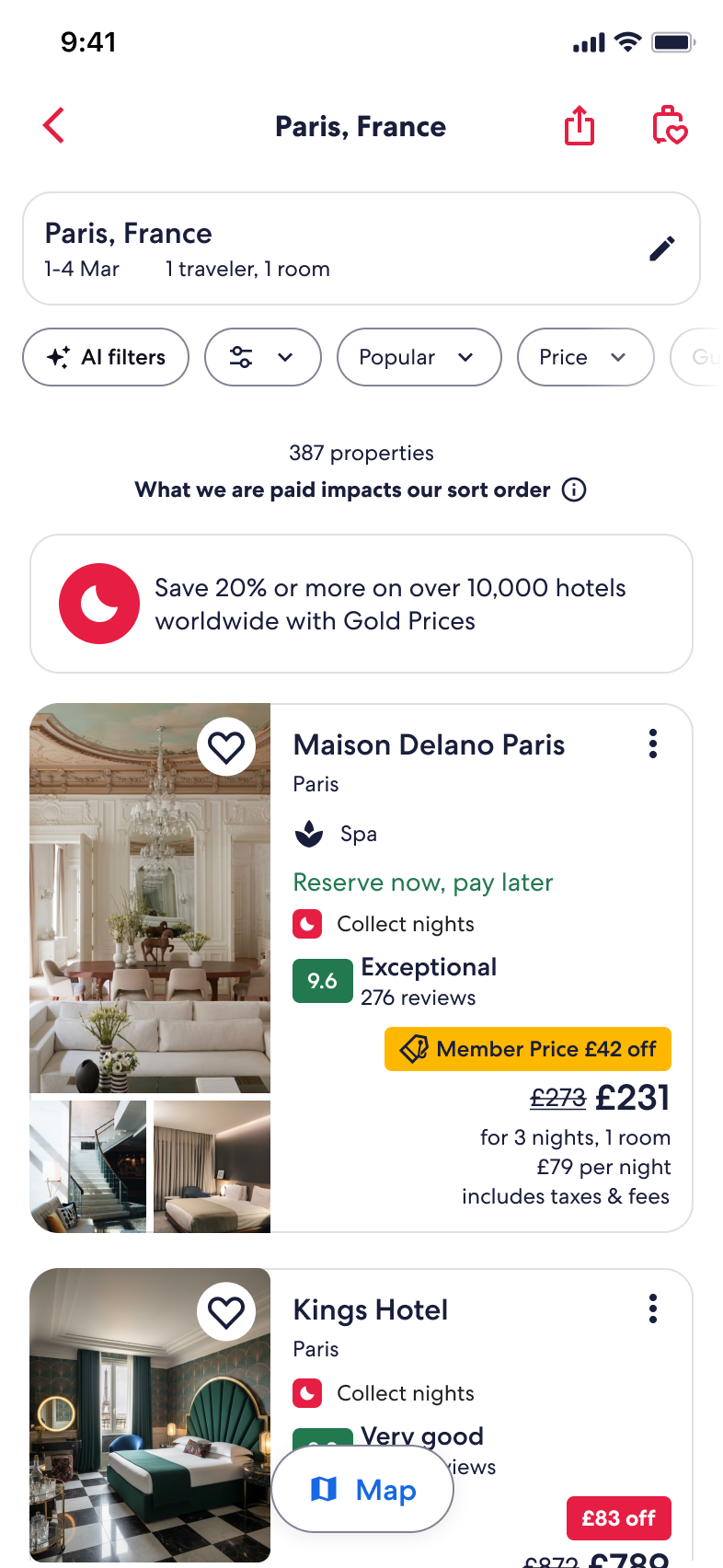
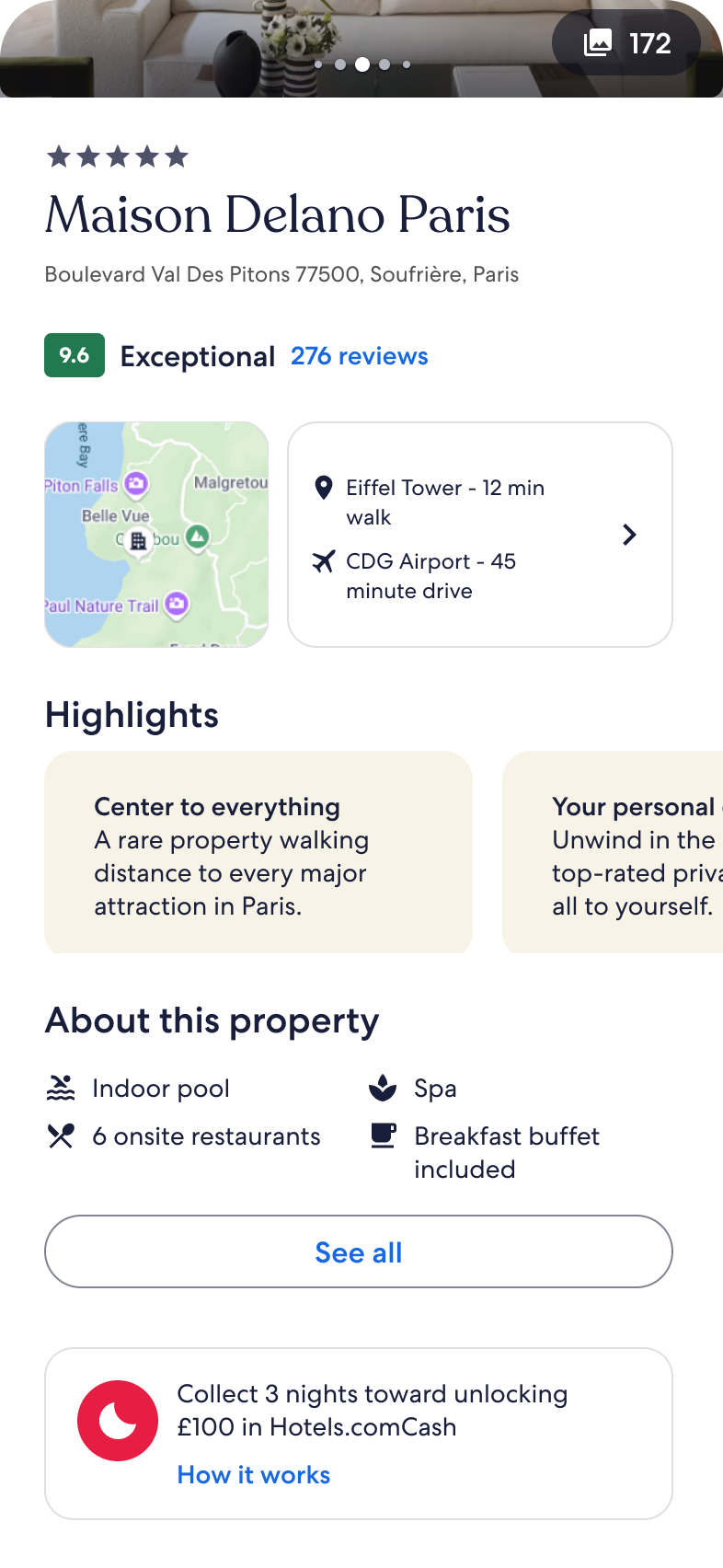
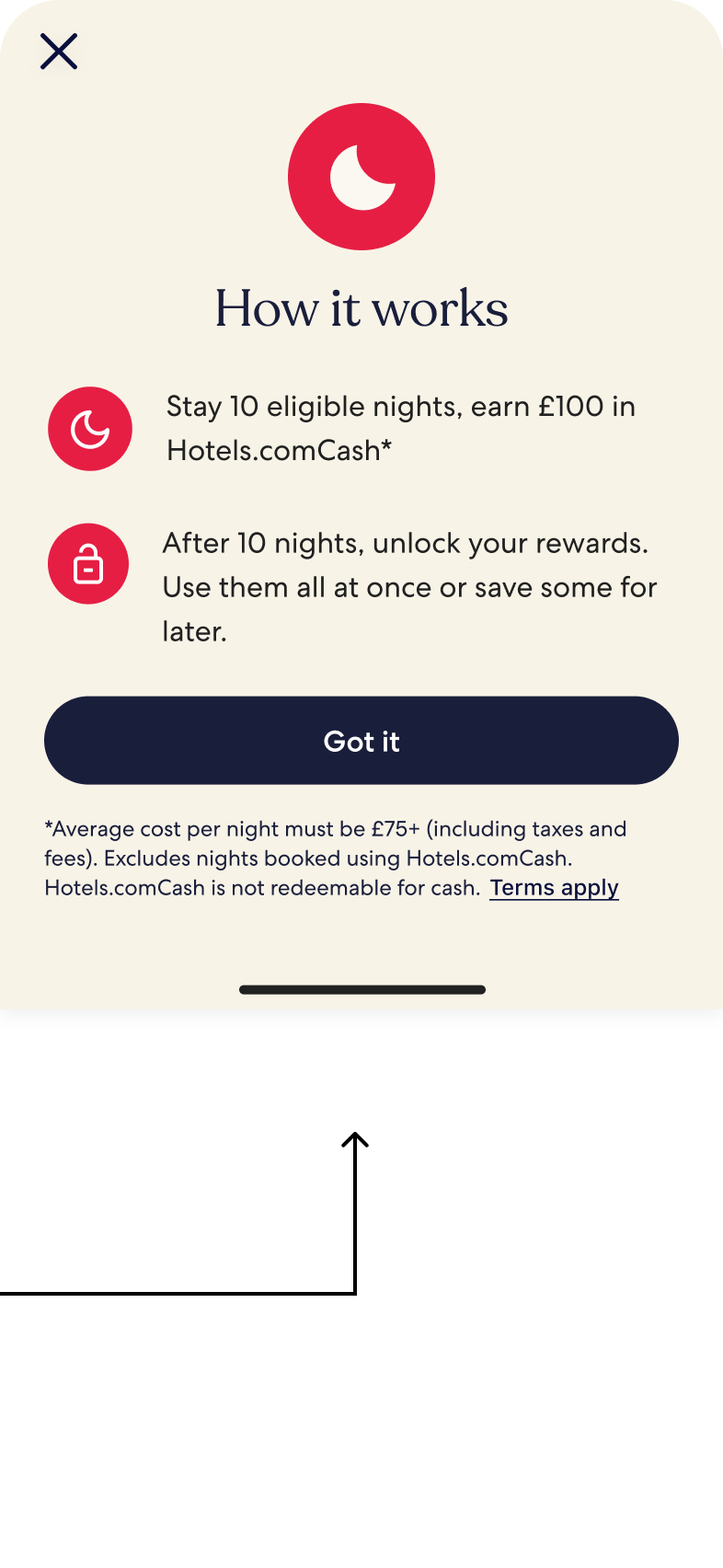
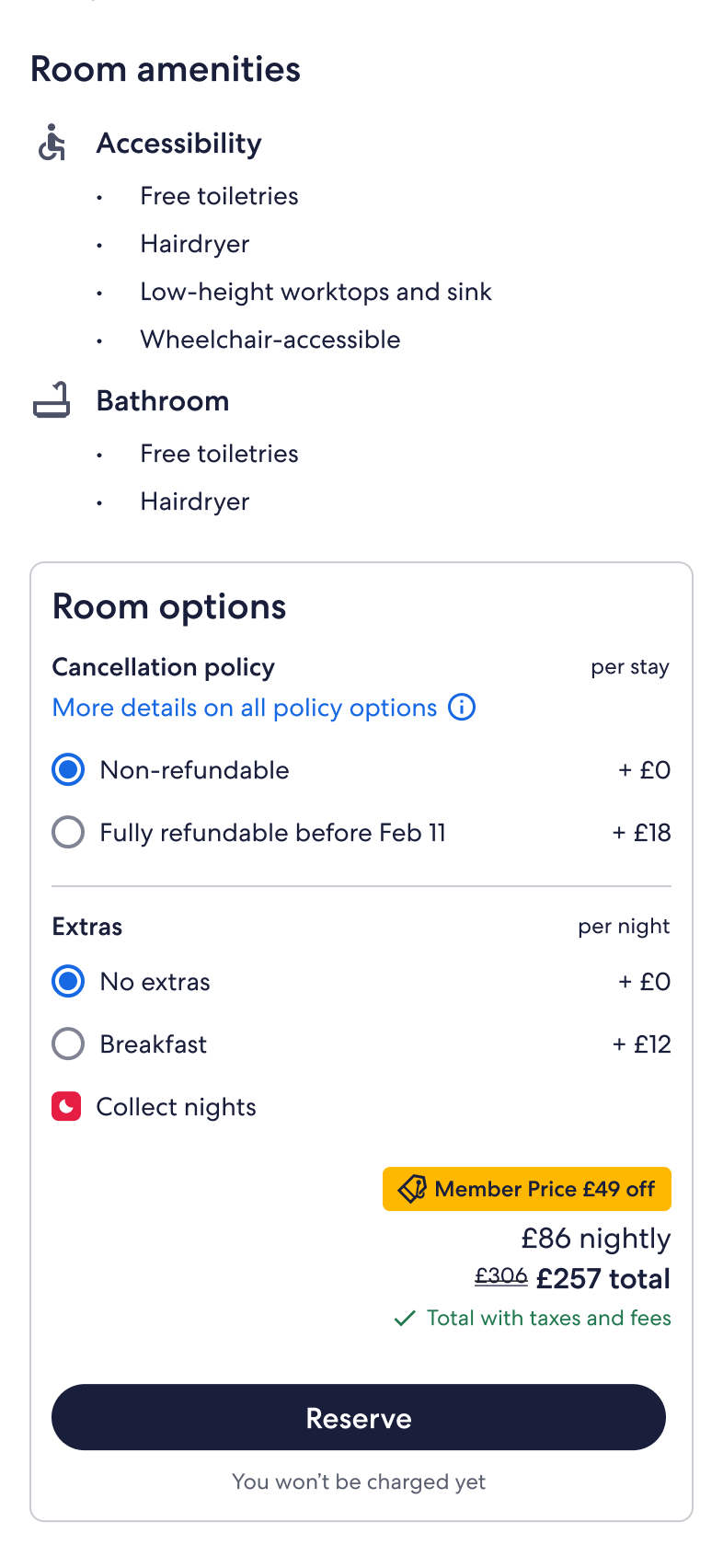
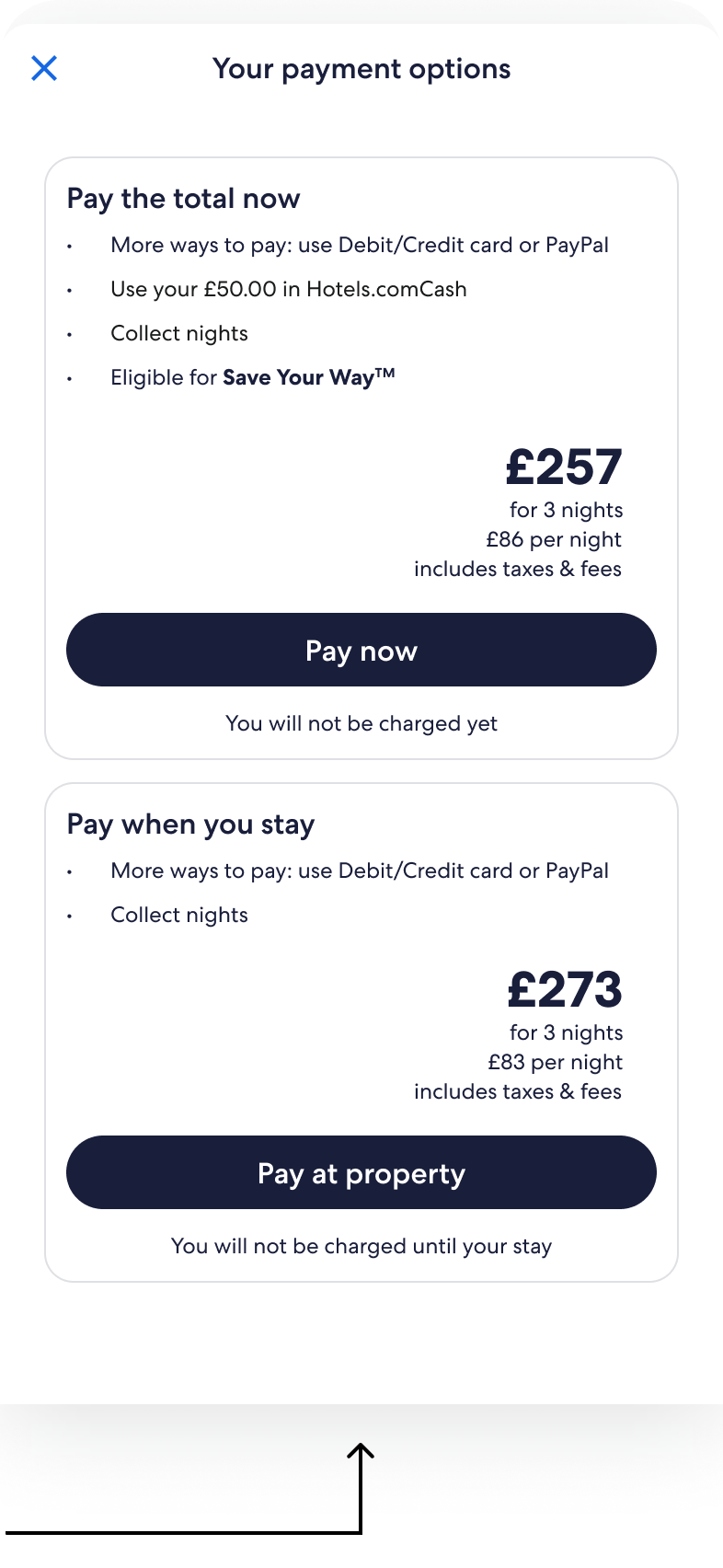
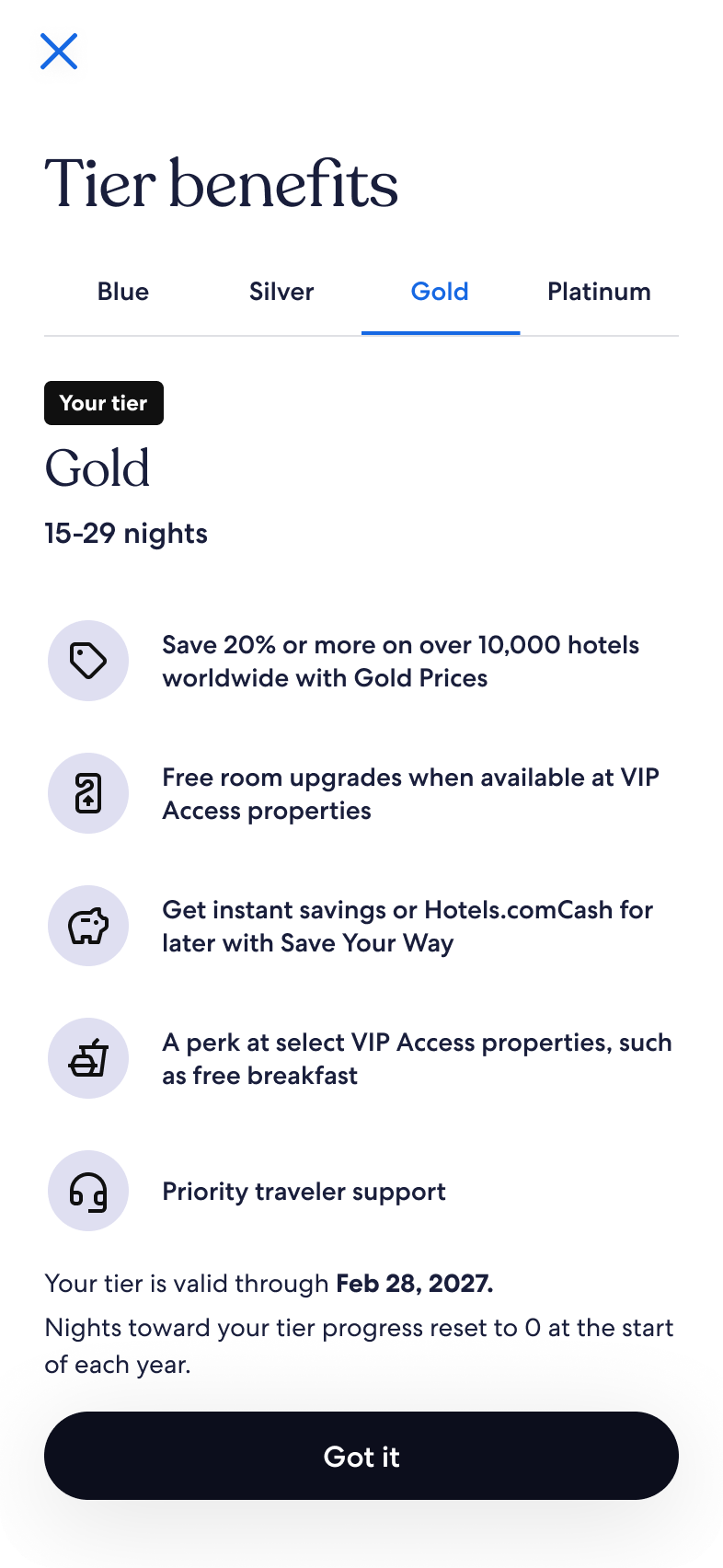
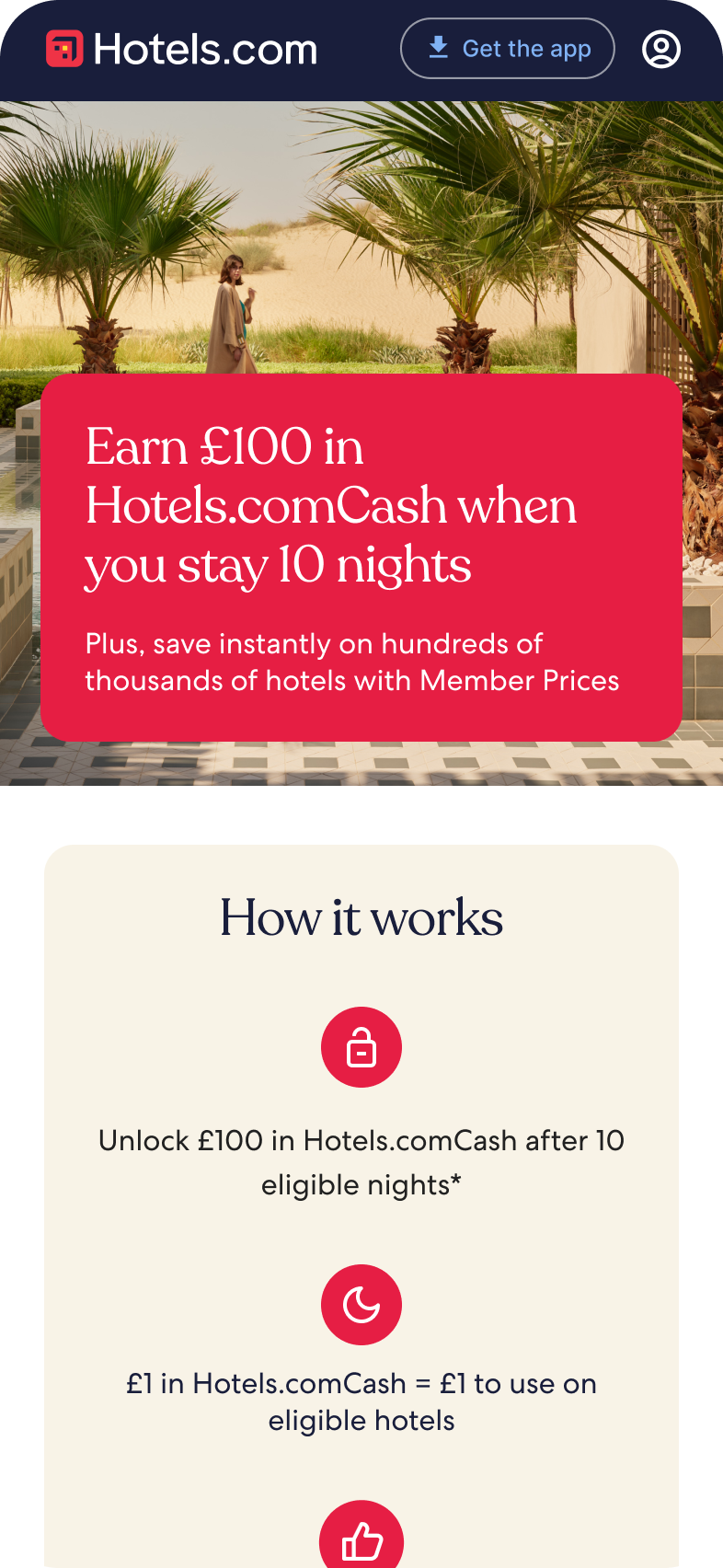
Stay 10 nights, get 10% back (International markets)
-
![]()
1. Onboarding Screen
-
![]()
2. Homepage Banner and Nights Counter
-
![]()
3. Homepage Info Sheet
-
![]()
4. Search Results Indicator on Property Cards
-
![]()
5. Property Page Progress Indicator
-
![]()
6. Property Page Info Sheet
-
![]()
7. Property Page Indicator
-
![]()
8. Payment Options Indicator
-
![]()
9
-
![]()
10
-
![]()
11
-
![]()
12
-
![]()
13
-
![]()
14
-
![]()
15
-
![]()
16
-
![]()
17
-
![]()
18
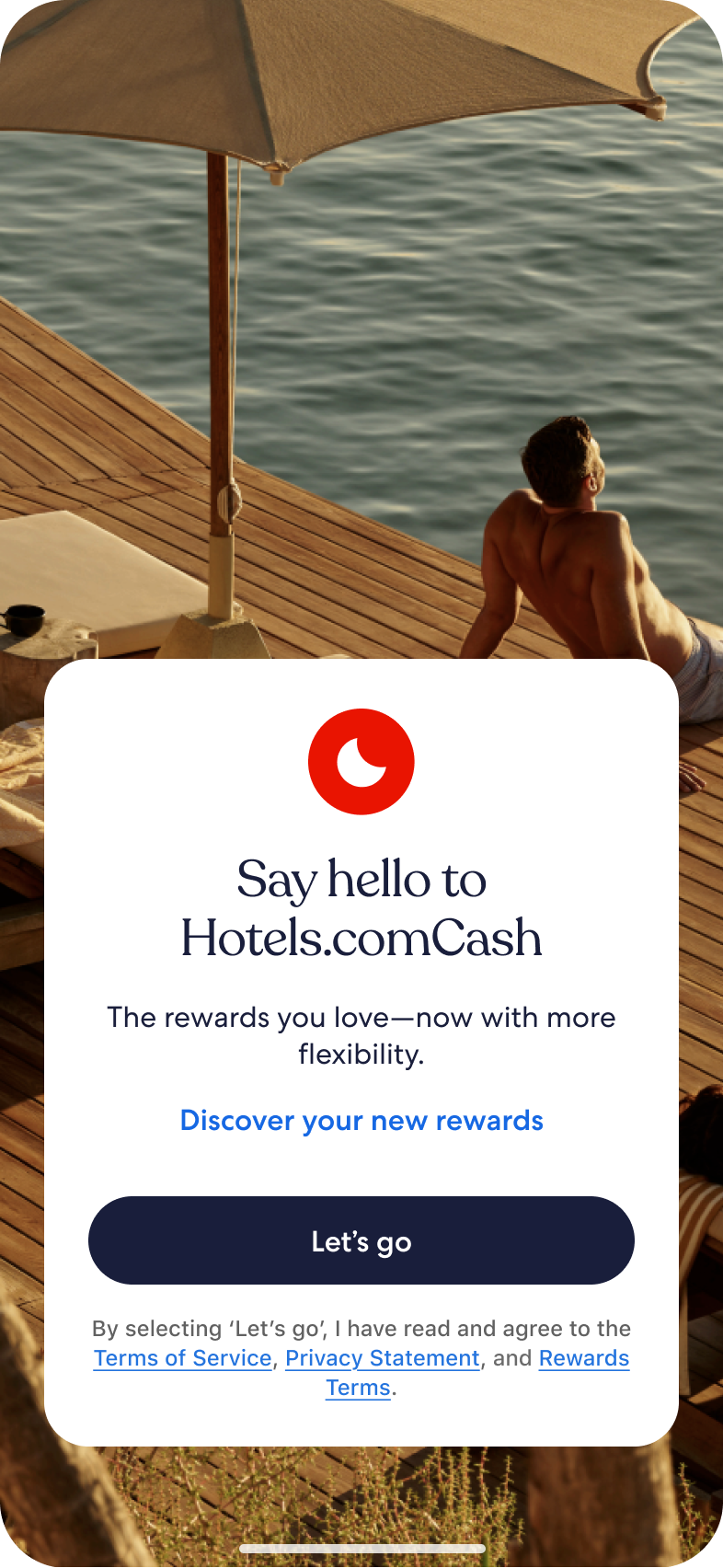
Data and Insights
-
The core “stay 10 nights, get 10% back” promise is attractive once travellers understand it.
Travellers were still anchored to the older “stay 10, get 1 reward night” model, so simplicity remained the benchmark they were using to judge the new experience.
When the value proposition was presented in the right order, travellers could explain it more accurately and felt clearer about the value.
-
Travellers liked the return to a clear 10:X promise. Across the broader Hotels.com research, the older “stay 10, get 1 reward night” benefit was consistently praised for its simplicity, familiarity, and ease of explanation; in amplification research, at least 9 in 10 members in each market said they fully understood it, and appeal scores were around 9.1–9.3 out of 10.
There were also specific interaction patterns that landed well. The punch-card or stamps metaphor was reassuring, easy to grasp, and emotionally motivating, with Brazil in particular responding well to the gamified feel of collecting progress toward a reward.
For 10:1 specifically, the positive signal was directional rather than friction-free: the programme was seen as appealing once the mechanics were understood, and the underlying idea of earning pooled Hotels.comCash was more flexible than the old reward-night model.
-
The main problem was not the reward itself, but understanding how it worked in practice.
Travellers got stuck on pending versus available rewards, unlock timing, expiry, and whether a booking actually counted. Checkout was a major friction point, especially around earn-versus-burn trade-offs and whether using rewards meant losing future value.
Trust also broke down when rewards appeared late, disappeared temporarily, or support could not explain what had happened. In those moments, confusion became a loyalty problem, not just a usability problem.
-
The messaging needed to do three things well.
First, it had to make the promise instantly clear: stay 10 nights, get 10% back. If the old reward-night model appeared too early, travellers assumed nothing had changed; if Hotels.comCash appeared too late, it felt confusing or hidden.
Second, it had to make the rules obvious. Travellers needed clear answers on what counts, what is pending, when value appears, when it can be used, and when it expires. Tracker research also showed travellers wanted more help with reward expiry, available benefits, and reminders about their balance.
Third, it had to reduce anxiety when something felt unfamiliar. That meant using plain language, explaining status changes clearly, and helping travellers understand edge cases such as coupons, local payment methods, instalments, or multi-currency behaviour.
-
10:1 = “I don’t understand how it works.”
10:100 = “I preferred the old program / this feels less valuable for me.”
10:1 was the more scalable model. It kept the clearer 10:X structure while using pooled Hotels.comCash, which made it more flexible than the old reward-night mechanic and easier to roll across many markets. From a business perspective, it created a broader ROW opportunity and the Italy and Taiwan results were strong enough to support continued rollout.
10:1 positives: flexible pooled reward value, reusable across many markets, and strong enough commercially to keep scaling.
10:1 challenges: harder to understand in the live experience, with more friction around pending status, redemption logic, and market-specific rules.
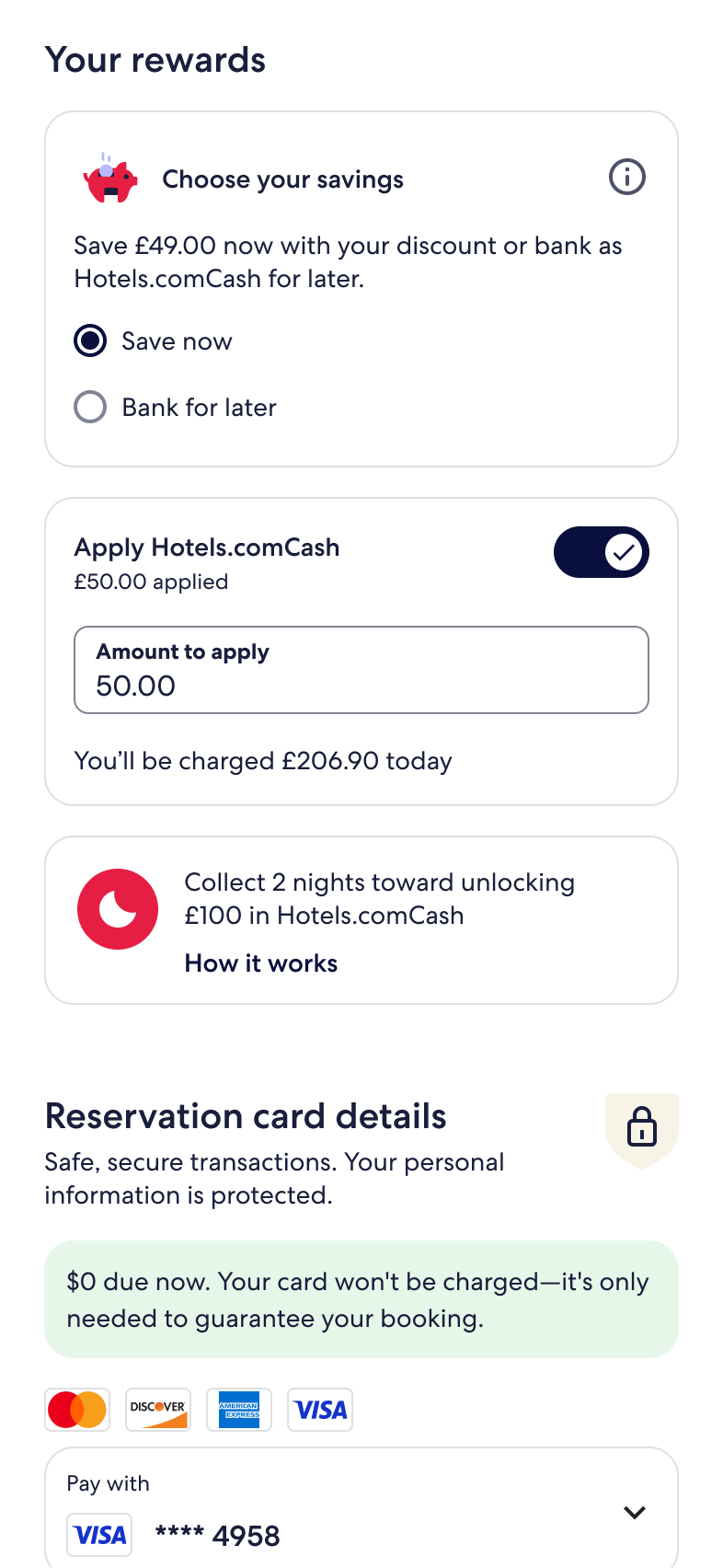
The nights-to-next-reward counter is missing from product page and checkout, which removes clarity in the highest-intent moments of the journey.
Travellers can’t apply Hotels.comCash while browsing, so the first real moment they see how redemption works is at checkout, and not visible during shopping when it could influence choice.
10:100 was the more intuitive model. “Stay 10 nights, get £100” was easier to explain and generally landed more cleanly in UK testing. From a business perspective, it offered strong economics and a clearer headline proposition, even if it came with more market-specific design constraints.
10:100 positives: clearer value story, easier comprehension, and attractive commercial upside at lower loyalty cost.
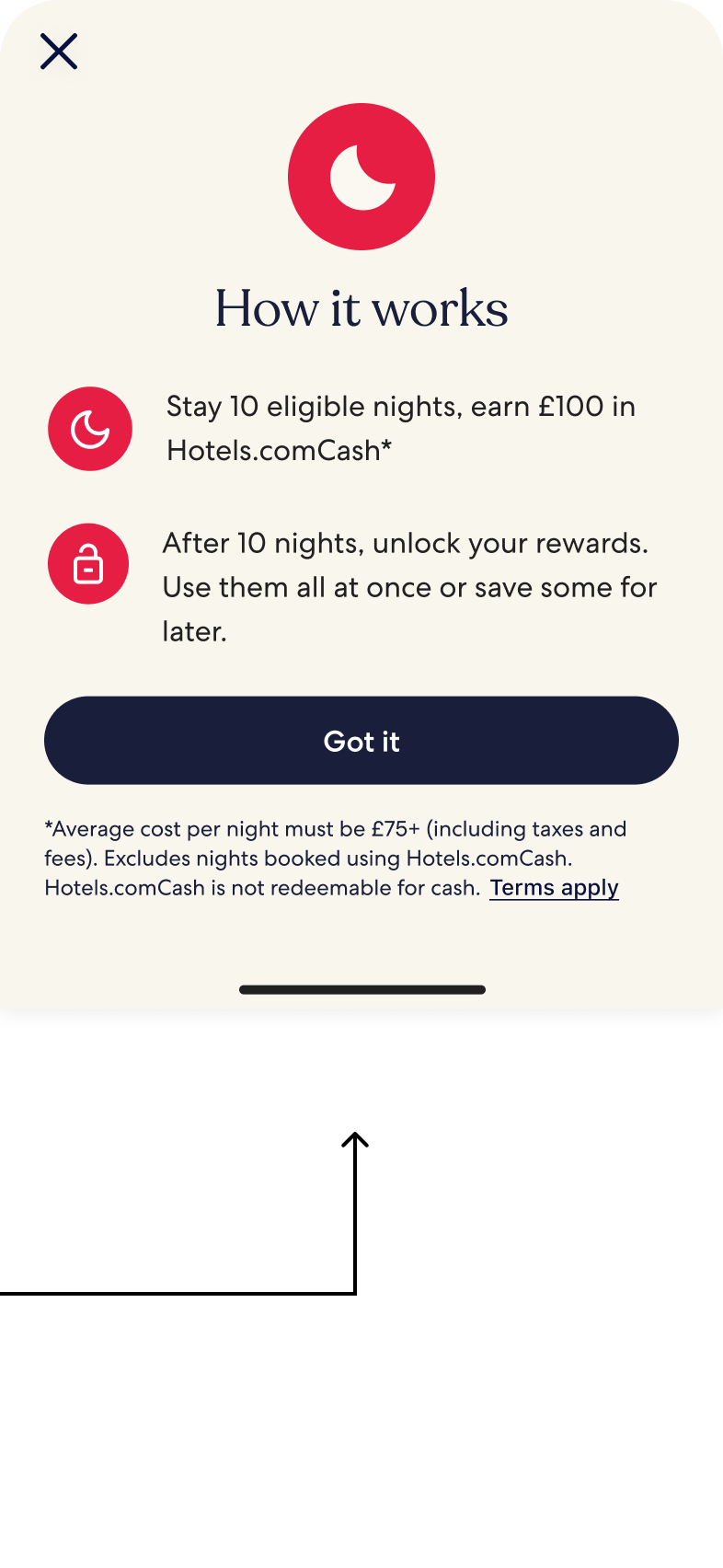
Travelers generally understand the headline proposition, but remain unclear on mechanics like the £75 average threshold, what counts as an eligible night, whether taxes and fees are covered, and how coupons or third-party rewards affect earning.
10:100 can feel more complex and less accessible, especially for lower spenders and infrequent travelers who see 10 nights as unreachable.
Higher-spend travelers were a specific pain pocket: they felt £100 was diluted relative to their spend and not compelling enough for expensive stays.
-
The 10:1 rollout was already large in scale: launch was complete in 6 markets, 17 more were in migration, and around 7 million members were already earning Hotels.comCash.
In Taiwan, post-launch measurement showed a statistically significant uplift in booking value versus the modelled baseline: +30.3% overall and +23.5% for Gold+ members. Italy showed no statistically significant deterioration and remained within expected ranges, which supported continued rollout with fixes in parallel rather than a stop-and-reset approach.
For 10:100, early UK tracking showed join rate recovering to around +10% to +13% YoY in the weeks after launch, while broader programme tracking framed the construct as a major reinvigoration bet with an $85M incremental NBV target through December.
On Reflection
-
This work was shaped by real delivery constraints. Requirements across product, comms, legal, and Rewards Hub were still evolving while engineering, platform, and design capacity were under pressure across multiple connected programmes. That meant many decisions had to be made quickly, with incomplete certainty, while keeping launch plans on track.
What I would do differently
I would push earlier for a sharper split between launch-critical work, enhancement work, and nice-to-haves so later trade-offs are made from a shared frame rather than under deadline pressure. I would also document key decisions more visibly so more of design leadership becomes legible beyond the room.
-
Some of the ideal experiences could not be supported at launch. The platform could not reliably calculate an unlock preview at checkout, loyalty APIs behaved differently across 10:1 and 10:100, and historic booking states introduced meaningful regression risk close to launch.
-
10:1 expansion could not be treated as a copy-paste rollout. The research audit and ROW BRD both highlighted significant market-specific complexity, including Naver Pay suppression and multi-currency clarity in South Korea, PIX suppression and instalment behaviour in Brazil, gift card rules in Canada, Sweden, and Australia, and local tax treatment in France.
-
The challenge was not only structural but emotional. Travellers were anchored to the older reward-night model, so even small moments of ambiguity could feel like value had been reduced or hidden. The design therefore had to manage reassurance, continuity, and trust throughout the transition, not just explain rules. The challenge was not only structural but emotional. Travellers were anchored to the older reward-night model, so even small moments of ambiguity could feel like value had been reduced or hidden. The design therefore had to manage reassurance, continuity, and trust throughout the transition, not just explain rules.
-
AI would not have replaced the leadership judgment this work required, but it could have reduced a lot of the volume work around it. Research synthesis tools could have surfaced recurring comprehension patterns faster, including pending-versus-confirmed confusion and the “£1 earned per £1 spent” misread. Content and localisation workflows could have flagged inconsistent terminology and residual One Key references earlier across many markets. Predictive testing could have identified hierarchy issues before formal studies, and automated QA could have caught visual drift without relying so heavily on manual review.
AI could also have helped generate first-pass analytics taxonomies, decision records, and PRD summaries, returning more time to the team for prioritisation, alignment, and judgment under pressure. On a programme running across multiple parallel workstreams with shared capacity constraints, that time return would have been material.
Outcomes
I led the design of a clearer, more motivating Hotels.com loyalty experience in the UK, then helped turn that thinking into a scalable international model by translating a complex rewards transition into something travellers could understand, trust, and use.
UK launch and early performance
10:100 UK launched on schedule, replacing One Key on Hotels.com UK. Early weekly tracking showed metrics generally within or above flag ranges, with join rate repeatedly above guardrails: 33.1% in the week ending 26 April, up 10.7% year over year, and 33.3% in the week ending 10 May, up 16.4% year over year.
The programme was framed against an $85 million incremental NBV target through December, making it a major reinvigoration bet for the brand. At the same time, post-launch voice-of-traveller feedback showed that clarity and confidence still needed work, with recurring themes including a preference for the previous scheme, confusion about how 10:100 worked, disappointment among some higher-spend travellers about the £100 cap, and concern among some budget-sensitive travellers about thresholds.
Italy and Taiwan as proof points
For 10:1, Italy and Taiwan became the proof points for scale (shipped ahead of schedule, migrated roughly 2.97 million members). Measurement showed a statistically significant uplift in Taiwan, including +30.3% in overall daily average NBV, +23.5% for Gold+ NBV, and +12.5% in booking volume versus the predicted post-launch baseline.
Italy showed no statistically significant deterioration in overall or key segment NBV or booking volume, with results remaining within expected ranges. That supported a Go/Fix-Go direction rather than a stop-and-reset approach.
Rollout at scale
The work was designed to scale beyond a single market or launch. An estimated $40 million incremental NBV opportunity in 2026 once all 10:1 markets are migrated and stabilised, and identified 10 focus markets (Brazil, Denmark, Norway, Sweden, South Korea, Canada, France, Hong Kong, Turkey, Switzerland) representing roughly 66% of 2025 NBV ex-US/UK in addition to 32 non-focus markets.


Testimonials
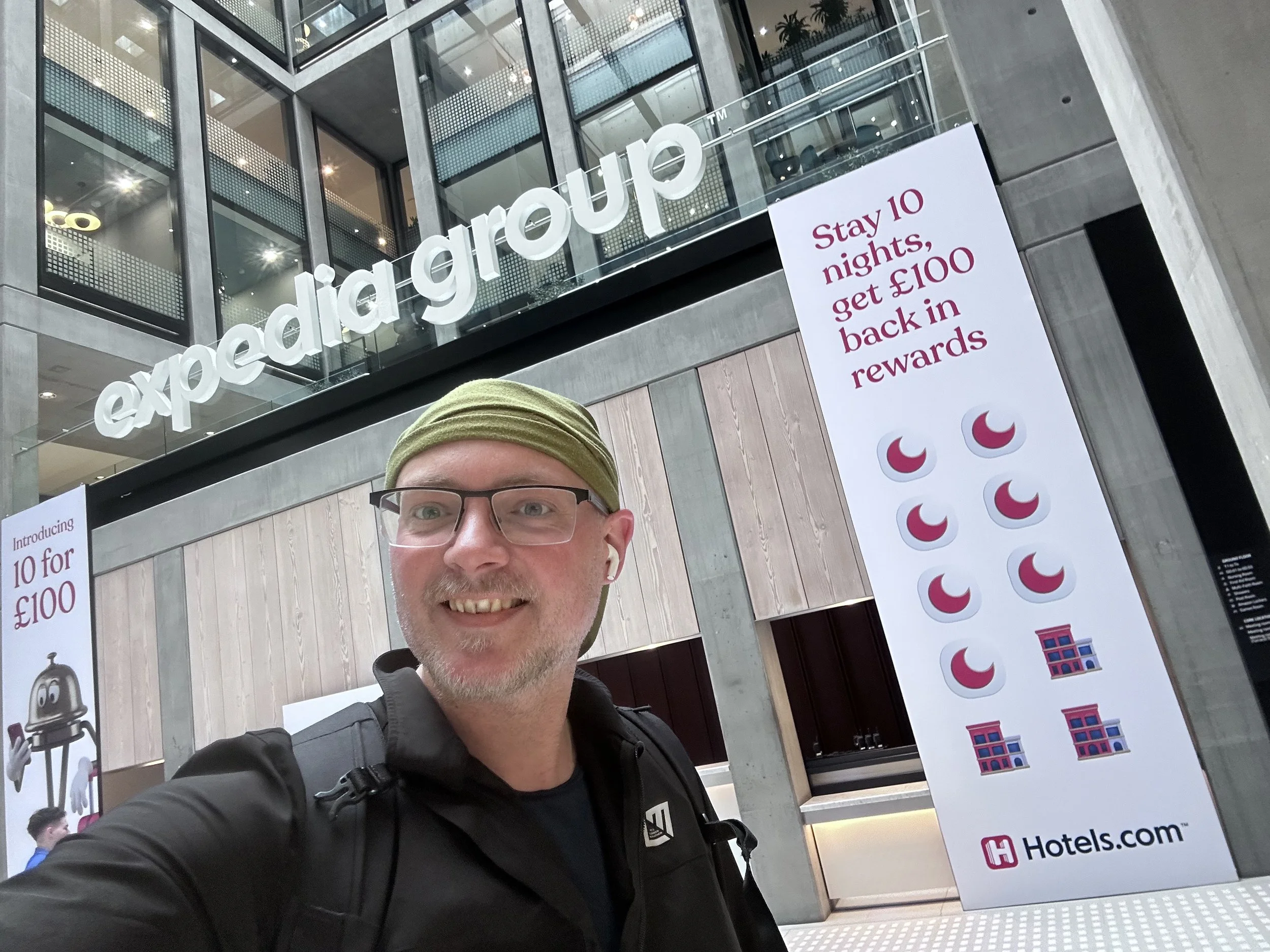
Working with Carl on Loyalty experiences at Expedia.